

Two refrigeration cabinets can look almost identical, offer similar storage capacity and perform the same basic function. But their energy consumption, and what they cost to run, can be very different.
For quick service restaurants (QSRs) and other foodservice businesses, refrigeration is an ongoing operating expense, with cabinets needing to maintain consistent temperatures throughout the day.
According to the Australian Government, commercial cooling equipment, including refrigerated cabinets and ice makers, can account for 25 – 85% of total energy use in businesses that rely on these systems. With energy representing a significant operating cost, understanding how refrigeration equipment performs can help operators and foodservice consultants make more informed purchasing decisions.
The purchase price doesn’t tell the whole story
When comparing commercial refrigeration, purchase price, capacity and dimensions are often the first things considered. But the initial investment is only part of the overall cost. A cabinet’s energy consumption determines how much electricity it requires to operate. Over several years, even relatively small differences in daily consumption can add up, particularly for businesses running multiple cabinets or operating across several locations.
The Australian Government recommends considering the lifetime cost of refrigerated cabinets, including purchase price, installation, maintenance and running costs. The trick is knowing how to compare the energy performance of different units.
Understanding kWh/24h
One of the most useful figures to look for when evaluating refrigeration is kWh/24h, which indicates how many kilowatt-hours of electricity a cabinet consumes over a 24-hour period under specified test conditions. This figure can be used to estimate annual electricity consumption and running costs.
The calculation is straightforward:
Daily energy consumption (kWh/24h) × 365 = estimated annual energy consumption (kWh)
Multiply that result by your electricity rate to estimate the annual electricity cost. For example, assuming an electricity rate of $0.30 per kWh and 365 days of operation, a cabinet consuming 10 kWh per day would have an estimated annual electricity cost of $1,095.
A similar cabinet consuming 15 kWh per day would cost approximately $1,643 annually. That’s a difference of around $548 per year, or $2,740 over five years, based on the same assumptions.
These are illustrative figures. Actual electricity costs depend on the tariff and operating conditions, but the calculation is a helpful way to compare the potential running costs of different cabinets.
How much difference can cabinet design make?
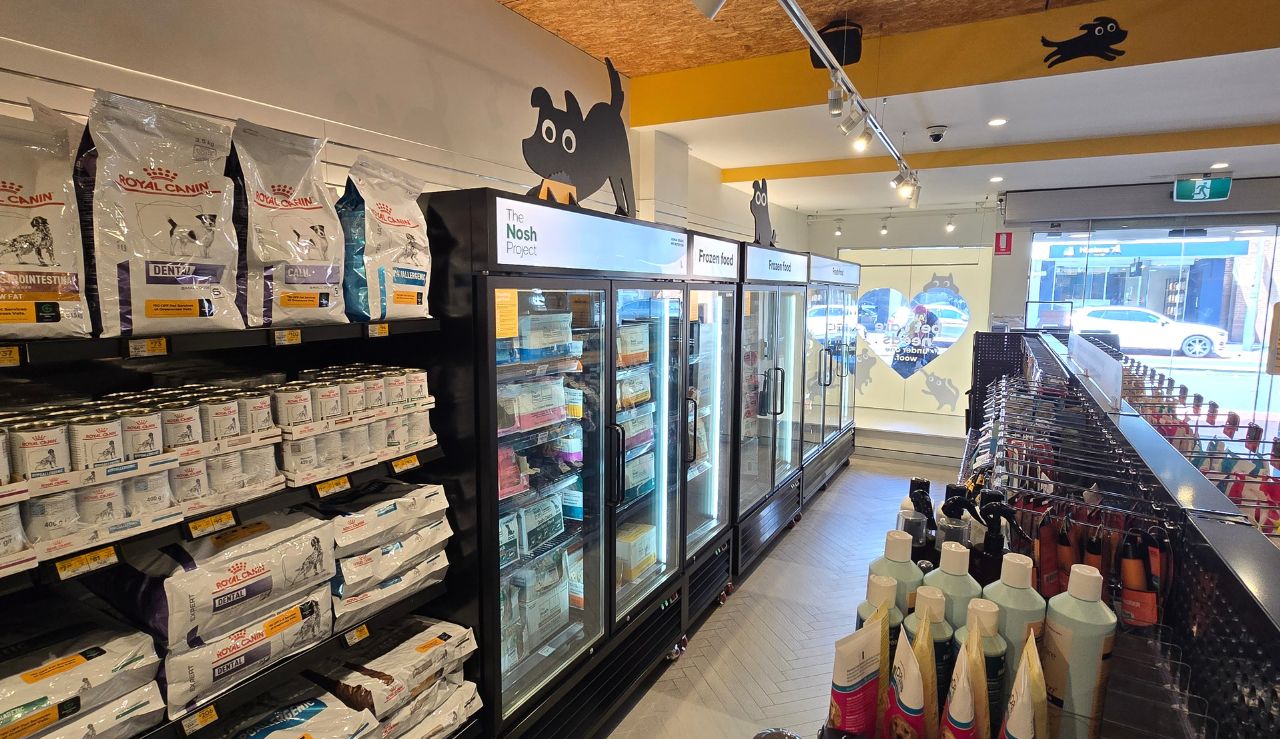
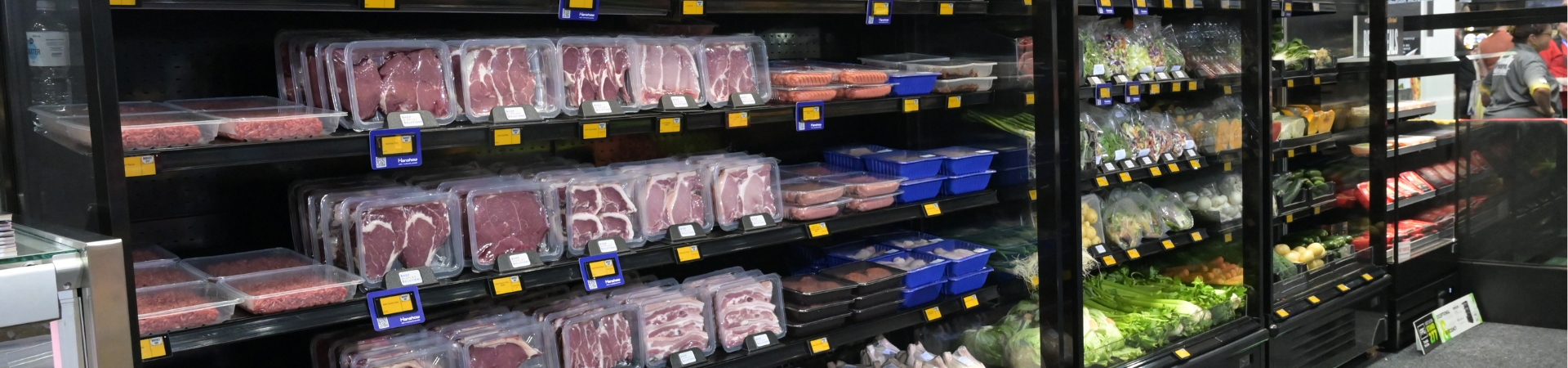
The way a refrigerated cabinet is designed can have a considerable influence on its energy consumption. Take open-front and doored multideck refrigeration.
Open-front displays allow customers to access products without opening a door, making them a practical choice for some self-service environments. Doored displays require an extra step to access products but help limit the exchange of cold cabinet air with warmer surrounding air. The difference in energy consumption can be substantial.
For example, two 1875mm full-height multidecks in the Bromic Refrigeration range have the following registered daily energy consumption figures:
| Model | Energy consumption |
|---|---|
| Bromic FHM1875-NR (open-front) | 21.6 kWh/24h |
| Bromic FHM1875HD-NR (doored) | 5.3 kWh/24h |
Daily energy consumption: 1875mm multidecks
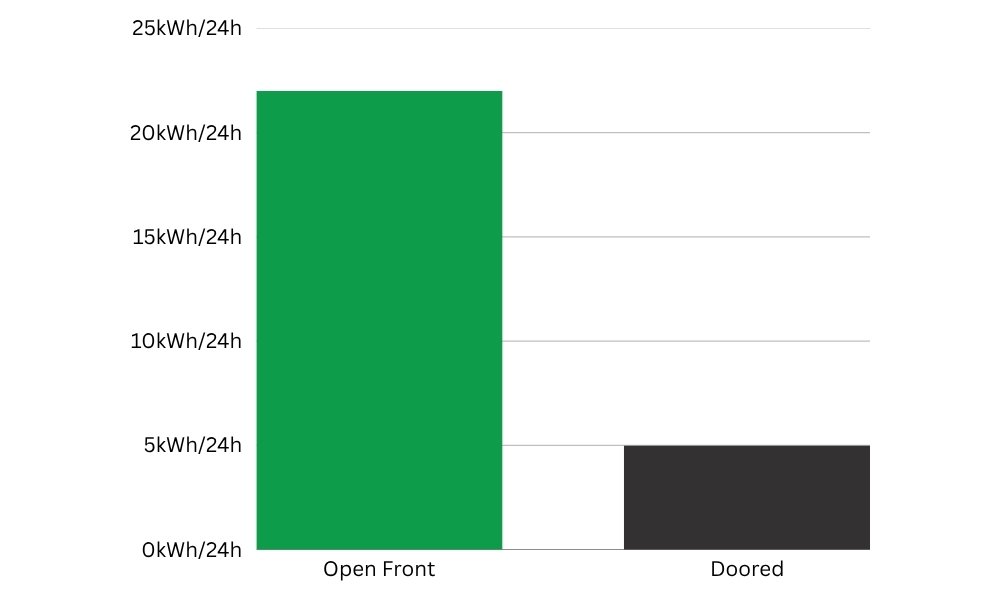
The doored model uses approximately 75.5% less energy under the stated test conditions.
Assuming an electricity rate of $0.30 per kWh, that equates to an illustrative difference of approximately $1,785 in annual electricity costs for a single cabinet.
Over five years, the difference would be approximately $8,925, assuming the same rate and daily energy consumption throughout.
That doesn’t automatically make a doored cabinet the right choice for every business. Customer access, product visibility, store layout and the way the space operates all need to be considered. It does, however, demonstrate how a decision about cabinet configuration can have a significant effect on ongoing energy costs.
Why comparing refrigeration isn’t always straightforward
Energy consumption figures are useful, but comparing cabinets on kWh/24h alone doesn’t necessarily provide a fair assessment. Two units may look similar but have different operating requirements or be tested under different conditions.
There are several specifications worth checking.
Cabinet capacity
A larger cabinet will generally have different energy requirements from a smaller one. Comparing the energy consumption of two cabinets without considering their usable volume or display capacity may give a misleading impression of efficiency.
Climate class
Commercial refrigeration is tested against specified ambient temperature and humidity conditions. Climate class indicates the conditions under which a cabinet’s performance has been assessed. This is especially relevant when selecting refrigeration for warm or demanding commercial environments.
M-pack temperature classification
M-pack classifications indicate the temperature conditions a refrigerated display cabinet is capable of maintaining during standardised testing. They are determined using test packages placed inside the cabinet to measure product temperatures.
Two common classifications for chilled display cabinets are M1 and M2.
| M Pack Temp | Cabinet Type | Temp Range | Suitability |
|---|---|---|---|
| M1 | Fridge | -1°C to +5°C | Perishables |
| M2 | Fridge | -1°C to +7°C | Non-perishables |
The key difference is the maximum permitted product temperature. An M1 cabinet maintains a lower maximum temperature (food safe under 5 degrees), than an M2 cabinet under the specified test conditions. This distinction is important when comparing energy consumption. Maintaining lower product temperatures can require more energy, so an M1 cabinet may have different refrigeration demands from a similar M2 cabinet.
For example, an M2 cabinet may appear more energy-efficient based on its kWh/24h figure, but it is permitted to operate with a higher maximum product temperature. Comparing it directly with an M1 cabinet without considering this difference could be misleading.
When evaluating refrigerated displays, check that the M-pack classifications are equivalent and that the cabinet can maintain the temperatures required for the products being stored.
Glass and cabinet construction
Cabinet design and insulation also influence energy performance. Features such as Low-E glass, argon-filled glazing and heated glass can affect heat transfer and energy requirements. These differences need to be considered alongside the intended application, rather than assuming that two glass-fronted cabinets will perform in the same way.
What about GEMS star ratings?
Australia’s Greenhouse and Energy Minimum Standards (GEMS) program provides energy performance information for regulated commercial refrigerated cabinets. GEMS star ratings offer another way to assess energy efficiency, with higher ratings indicating better energy performance within the relevant rating framework.
However, the Australian Government advises comparing star ratings only between refrigerated cabinets of the same type, size and operating temperature.
A cabinet with a higher star rating is not necessarily the best choice for every application. It still needs to provide the appropriate storage capacity, temperature performance and access for the business.
Operators and consultants can check registered products and their energy performance information through the Australian Government’s Energy Rating database.
Why warranty coverage belongs in the cost equation
Energy consumption isn’t the only ongoing cost to consider when purchasing commercial refrigeration. Repairs and servicing can also affect the total cost of ownership, particularly for businesses operating multiple cabinets or locations.
Warranty coverage can help reduce unexpected repair expenses, but not all warranties offer the same level of protection. Some cover replacement parts only, leaving businesses responsible for labour costs. Others include both parts and labour, providing more comprehensive cover if equipment requires repairs during the warranty period.
It’s also worth checking the warranty duration, what’s included and any conditions that apply. For example, Bromic Refrigeration offers a 5-year parts and labour warranty across its range, helping businesses manage potential repair costs over a longer period.
When comparing equipment, understanding the warranty alongside energy consumption and purchase price provides a more complete picture of long-term ownership costs.
Looking beyond the initial investment
For a QSR operator purchasing refrigeration for a single venue, understanding the potential annual running cost can help inform the purchasing decision. For businesses operating multiple locations, the financial implications can be considerably greater.
Foodservice consultants also have an opportunity to consider energy consumption during the equipment selection and specification process, alongside layout, capacity, access and product temperature requirements.
The lowest energy cabinet isn’t necessarily the right cabinet for every application. But understanding how much electricity different units consume, and why, gives businesses a clearer picture of what they’re investing in.
When refrigeration is expected to operate reliably for years, the cost of running it deserves as much consideration as the price of buying it.
Sources and further reading
- Australian Government, Research before you buy: commercial ice makers and refrigerated cabinets, 15 June 2026.
- Australian Government Energy Rating, Refrigerated cabinets.
- Australian Government Energy Rating Registration Database.
- Bromic Refrigeration technical product data for FHM1875-NR
- Bromic Refrigeration technical product data for FHM1875HD-NR